Related links
Downloads
External links
BBSRC is not responsible for the content of external websites
'Stand-alone' LINK
Changes to this scheme have been implemented following an independant evaluation report from a specialist review panel, available at: Industrial Partnership Award and ‘stand-alone’ LINK schemes evaluation. Our Grants guide has also been revised to reflect this update.
Application deadline: as per next responsive mode
LINK applications involve collaborative research with at least one company and one science-base partner (projects with SMEs are particularly favoured) where at least 50% of the full economic cost of the project comes from industry (see FAQs for example calculations). Applications should be for pre-competitive research that would not be undertaken in this form without LINK support.
Applications are assessed by our Research Committees, alongside standard applications, using the same criteria. LINK projects are normally funded in preference to standard grants of equivalent scientific merit.
Partners must agree ownership and exploitation of intellectual property arising from the project at the outset. An appropriate management framework must be in place with defined scientific and commercial deliverables.
Benefits for company partners include:
- financial support for the project
- closer relationships with the science base
- possibility of recruiting appropriately trained staff at the end of the project
Essential criteria
- The project involves collaborative research with at least one company and one research-base partner
- Overall Government support for a project is no more than 50%
- The application is for research that is pre-competitive in nature
- Arrangements for ownership and exploitation of intellectual property arising from the project have been agreed by the partners
- The project has an appropriate management framework and both the scientific and commercial deliverables are clearly defined
Before applying
The company partner should be registered in the UK or have a UK R&D or manufacturing site. Where a suitable company cannot be found in the UK, an overseas company may be used. However, such collaborations are judged on a case by case basis, and clear justification must be provided. We strongly encourage you to contact us (contact details below) prior to submission if you wish an overseas company to be an industrial partner under this scheme.
Applicants should describe the value of the partnership and its mutual benefits. Applicants should include a letter from their university's Technology Transfer office stating that should the LINK application be funded, a collaborative agreement will be put in place with the industrial partner before commencement of the project. The letter should:
- describe the expected LINK partnership management and distribution strategy of this collaboration
- be signed off by the industrial partner budget holder (or equivalent) as well as colleagues in the institutions Technology Transfer Office (or equivalent).
Please consult the FAQs in the downloads section for calculating grant costs and contributions.
If you are interested in submitting an application for a LINK project please contact a Programme Manager (contact details below) to discuss your application.
How to apply
Visit our 'Apply for funding' section to submit your application through our electronic submission system.
For more specific guidance about applying to this scheme, please consult the FAQs (see downloads).
The schemes are dictated when selecting classification as follows:
- Select Council: 'BBSRC'
- Select Document Type: 'Standard Proposal'
- Select Scheme: 'Responsive Mode'
- Select Call/Type Mode: 'Responsive Mode [deadline]'
- In the Document Menu select 'Classifications' and then 'Grant Type'
- Select the appropriate classification (Industrial Partnership Award, LINK etc)
Applications are processed alongside other responsive mode applications. Application deadlines are therefore the same as responsive mode applications. Responsive mode deadlines can be found on our 'Apply for funding' page (see related links above).
Case study 1
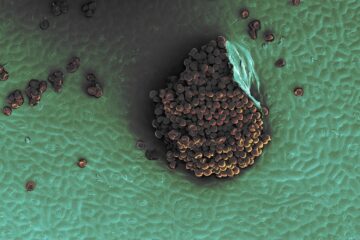
Mouse oocyte (egg) and surrounding cumulus cells stained for both DNA and chromatin epigenetic marks
© Santos, Dean and ReikThe biology of the reprogramming process to improve the generation of iPS cells
A 3-year stand-alone LINK project launched in March 2010, in full collaboration with the company CellCentric, focuses on new epigenetic reprogramming factors involving functional testing of embryonic stem (ES) and induced pluripotent stem (iPS) cells in mice using staining techniques to provide fluorescent markers to show the development of DNA modulators.
This integrated programme of work is headed by Professor Wolf Reik at the Babraham Institute. With a grant from the BBSRC, this project will contribute to our understanding of the healthy ageing process and provide new avenues for regenerative medicine and the pharmaceutical industry.
Case study 2
The potential role of soluble plantain fibre and its components in preventing colonisation and invasion of the intestinal mucosa by Salmonella typhimurium bacteria
A 2-year project launched in October 2009 and funded by a stand-alone LINK grant from the BBSRC is being conducted by Professor Jonathan Rhodes from the University of Liverpool and in collaboration with industry biotech partner, Provexis plc.
Professor Rhodes is extending the research carried out so far by Provexis and others, that has proven, after testing a range of soluble plant fibres in vitro, that soluble plantain (green banana) fibre is particularly effective at inhibiting pathogen-epithelial interaction in the intestine.
The aim now is to assess, not only whether the addition of soluble plantain fibre to poultry feed reduces salmonella colonisation and invasion, and which fibre fractions are most inhibitory but also, to then to obtain preliminary characterisation of the composition and structure of these fibres.
LINK programs
BBSRC has previously supported LINK projects through the Defra-led LINK programmes. These LINK programmes are no longer open to consider new applications. Further information on these programmes can be found in external links above.
Case studies
QUOATS - Harnessing new technologies for sustainable oat production and utilisation
A five-year Sustainable Arable LINK project launched in September 2009, QUOATS is led by Aberystwyth University (IBERS) and is jointly sponsored by:
- BBSRC
- Defra
- Welsh Assembly Government's Academic Expertise for Business (A4B) programme with European Regional Development funding
- Scottish Government Contract Research Fund
- AHDB and industry partners
![]()
Dr Athole Marshall of IBERS, Aberystwyth University leads the QUOATS project © IBERS
Harnessing the unique properties of oats both as a plant and a grain we can address some of the emerging problems with cereal cultivation and at the same time deliver an environmentally benign crop which offers considerable health benefits for human and livestock consumption.
The QUOATS project seeks to develop oats with the agronomic qualities, yield, economic competitiveness and quality traits that meet the need of growers and industrial end-users. It is developing powerful enabling technologies for the identification of specific genes and molecular markers associated with key traits. In collaboration with academic partners and industrial end-users across the whole production chain.
The project capitalises on the value of oats as a profitable component of sustainable arable production for human and livestock consumption and for industrial end uses as proven by the earlier, and very successful, OatLINK project.
For more information visit the project website at www.quoats.org.
Conversion of high sugar grasses to alcohol based transport fuel (Grassohol)
![]()
© IBERS
A 3-year Renewable Materials LINK project launched in April, 2009 focusing on sugar-rich varieties of perennial ryegrass, developed at Aberystwyth University's Institute of Biological, Environmental and Rural Sciences (IBERS), as a raw material for producing bio-ethanol. With funding from Department for Environment, Food and Rural Affairs (Defra), the Department of Energy and Climate Change (DECC) and the BBSRC, the project brings together the expertise of 8 partners from industry. Project Director Dr Joe Gallagher. "It offers significant potential for biofuel production and the involvement of each partner demonstrates the commercial importance of the research as we move inexorably towards a bio-based economy".
The team are experimenting with different soils, fertilizers and companion crops such as white clover, with the aim of reducing dependency on artificial oil-based fertilizers. Early results are promising and indicate that up to 4,500 litres of ethanol per hectare of ryegrass could be produced every year, comparable with other energy crops but with the advantage of being environmentally friendly, capable of growing on poorer land and with cheaper management costs.
Controlling supply, quality and waste in brassica vegetables: Understanding the genetics of maturity to breed varieties in response to climate change
![]()
© Sue Kennedy, Elsoms
![]()
© Sue Kennedy, Elsoms
A Horticultural LINK project launched in July 2009 and funded solely by us in collaboration with industry partners from Bejo Zaden B.V., Weatherquest and Elsoms Seeds.
Project leader Dr Judith Irwin from the John Innes Institute is coordinating a consortium that is working on controlling supply, quality and waste in brassica vegetables, and understanding the genetics of maturity to breed varieties in response to climate change.
Contact
Jo Holbourn
industry.collaboration@bbsrc.ac.uk
tel: 01793 413339